
The Evolution of Global Pop Music in Iran up to the Late 1970s
Pop music, or people's music, is a dominant and prevalent form found in every nation's musical landscape. With its expressive style and abundant aesthetic elements, it brilliantly reflects the emotions and sentiments of the public. This music, which in Iran has roots even older than Persian poetry, emerged from the myriad of public ceremonies, both joyful and sorrowful, and the ups and downs of social life. It's this popular, grassroots dimension that has ensured its lasting presence and global reach.
October 7, 2025
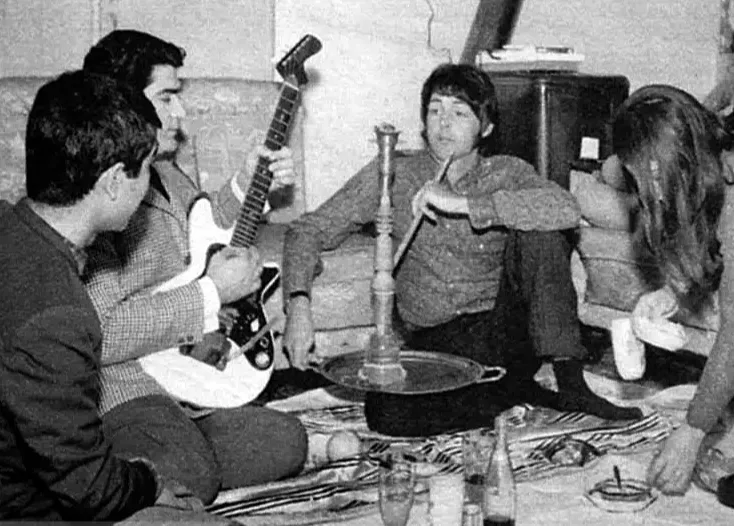
Paul McCartney smokes a hookah at Vigen’s house
Introduction
Pop music (or "people's music") is a dominant and universal art form that expresses the public's feelings, emotions, joys, sorrows, epics, and aspirations. From a social psychology perspective, the spread of this music across different social strata is akin to a fundamental human desire. It can survive for centuries and may even endure as the sole cultural legacy of forgotten societies and civilizations.
Iranian music is no exception to this rule, boasting roots that predate Persian poetry itself. Rather than merely being a source of entertainment for rulers and the elite, this music reflects the diverse facets of people's individual, social, and national lives. Its popular, grassroots dimension is as old as Iranian music history. This genre evolved within the context of various ceremonies—those of grief, celebration, labor, struggle, victory, and defeat.
However, similar to the country's social history, Iran's past popular music has often been overshadowed by its political history and governmental conflicts, leading to insufficient scholarly attention and rigorous research. Available historical and musical accounts from the last two or three centuries, mostly written by Orientalists and foreign travelers, are often biased and incomplete.
Early Western Influence on Iranian Music
The influence of Western culture on Iranian music shares a history similar to the broader trend of "Westoxification" (Gharbzadegi) seen in other aspects of the national culture. Early evidence of this influence can be found in the Qajar-era recordings, notably:
- The piece "Peti Juli" (1905 AD / 1284 SH)
- The piece "Ma-chiche" (1909 AD / 1288 SH), which was recorded on a gramophone record
Later, major global shifts like the two World Wars devastated the cultural and social patterns of defeated countries, leading to music forms like Jazz and Blues becoming globally dominant genres in the 1920s.
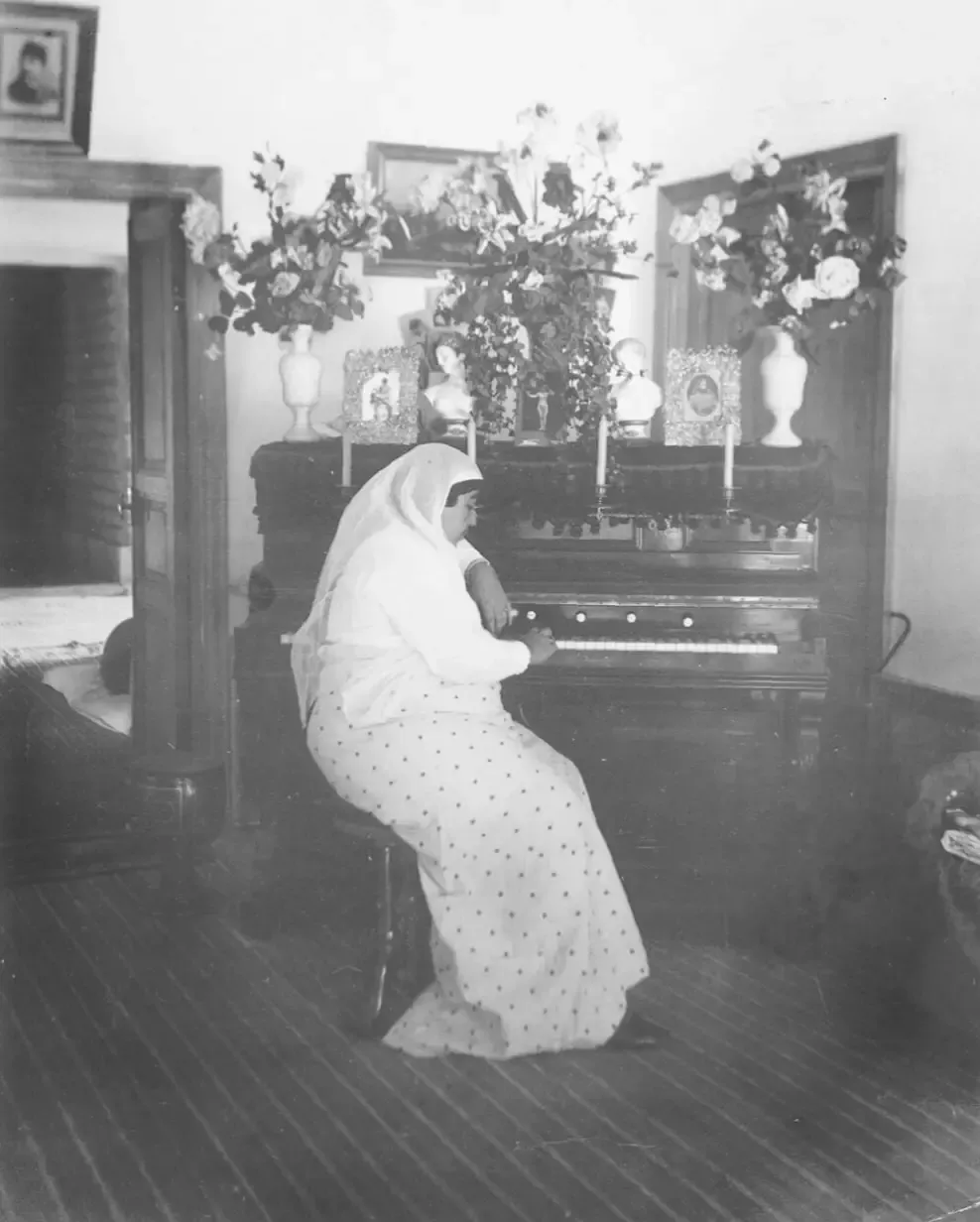
Nasser al-Din Shah's granddaughter playing the piano
Expansion of Pop Forms After 1305 SH (1926 AD)
Further examples of the penetration of Western forms included pieces like:
- "Isfahan Waltz," titled "Hediyeh-ye Khak" (Gift of the Earth), performed by Badizadeh.
- Duet Tasnifs (vocal compositions) such as "Raz-e Eshgh" (Secret of Love), featuring Badizadeh and Nayerazam Roumi, accompanied by Morteza Khan Mahjoubi's orchestra in 1312 SH (1933 AD).
The impact of the four-piece (Quartet) and six-piece (Sextet) structure common in 1920s Jazz became fully evident in Iranian recordings from 1307 SH (1928 AD) onwards. This influence could be seen in orchestras like:
- The four-piece orchestras of Hossein Ostovar, Mostafa Nouriani, and Parviz Iranpour.
- The six-piece orchestras of Moshir Homayoun and Mousa Ma'roufi in their 1312 SH (1933 AD) works.
The presence of a prominent figure like Abolhassan Saba and the recording of discs such as "Danesh Comic Foxtrot-e Ash-e Reshteh" (The Scientific Comic Foxtrot of Noodle Soup) and "Golbandak" with the voices of Rouhafza and Farahangiz Khanom in 1312 SH (1933 AD) paved the way for more artists, including Seyed Javad Badizadeh. His collaboration with Esmaeil Mehrtash was a key development in this trend.
Ultimately, a new generation of popular music was born from the fusion of Iranian music and Western (Farangi) forms, often utilizing comic or colloquial lyrics.
Recordings from this new era, such as "Mashin-e Mashti Mamdali" (Mashdi Mamdali's Car), "Zaalzaalak" (Hawthorn), "Yeki Ye Pool-e Khorous" (One Rooster Coin), and "(Kolft) A la Garçon" (Maid A la Garçon), were notable examples. These tracks were recorded in Syria in 1314 SH (1935 AD) and in Berlin in 1316 SH (1937 AD).
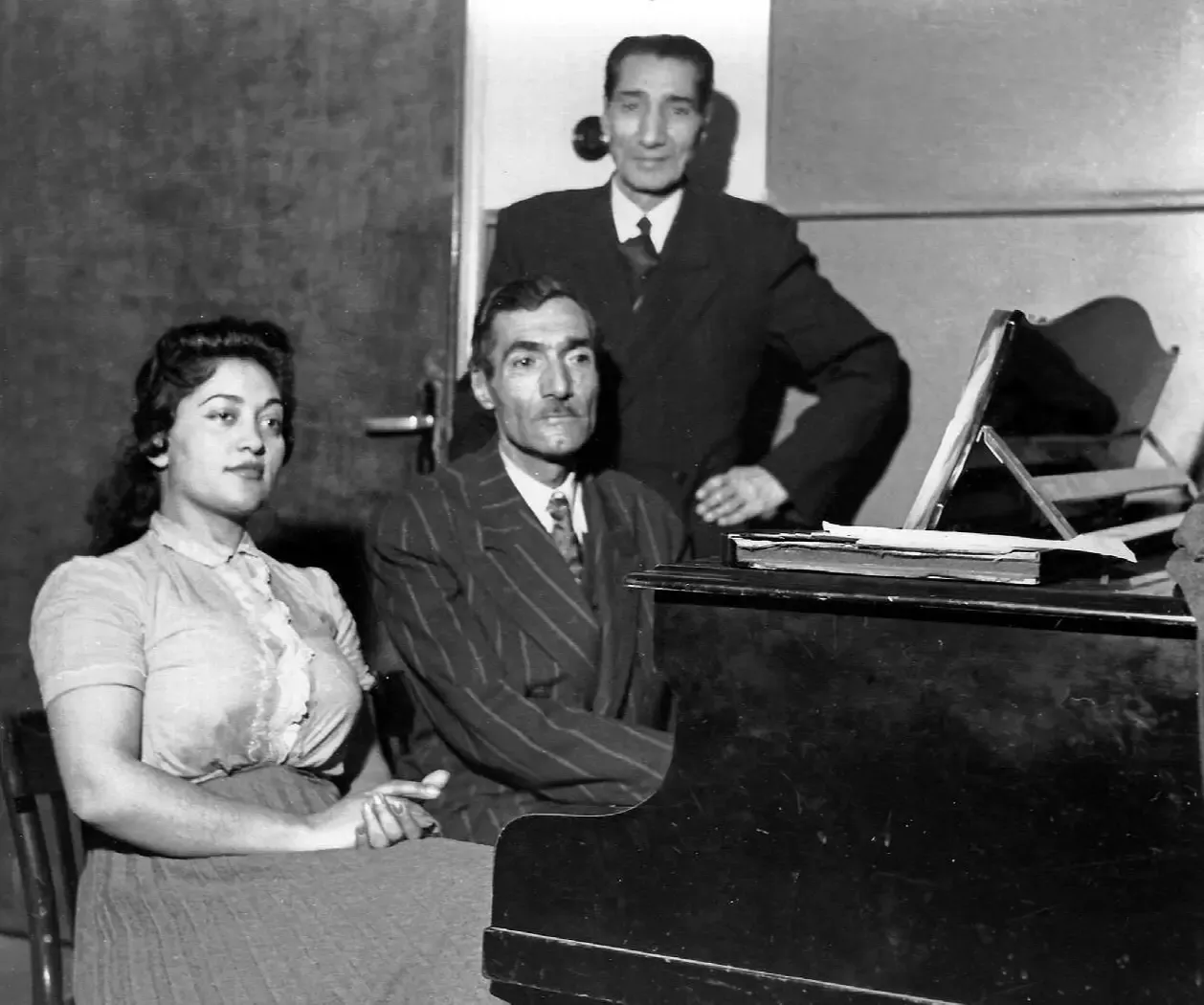
Adib Khwānsāri, Mortazā Mahjubi, and Marziya at Maydān-i Arg Radio Studio, Tehran.
Popular Music Styles After 1320 SH (1941 AD)
While the traditional tasnif (vocal composition) and rhythmic pieces (zarbi-khani) had always been widely popular—as evidenced by the many examples collected by Zhukovski in Shiraz, Isfahan, and Tehran in the late 19th century, and the enduring fame of artists like Qamar-ol-Molouk Vaziri and Molouk Zarrabi—this newer, blended style of popular music also gained massive public appeal.
The establishment of Radio, the influence of Arabic and Indian films, the fusion of acting and music within the Barbad Society, and the formal training provided by the conservatories all created distinct and influential cultural trends.
Academic training, particularly in music and acting at institutions like the Higher Music School (and its subsequent forms) and the establishment of the Higher Acting Conservatory, prepared the necessary human capital. Many of the artists who shaped these new styles were graduates of these very centers.
The Rise of Pish-Pardeh-Khani (Overture Singing)
The Pish-Pardeh-Khani style emerged from the theater environment around 1315 SH (1936 AD). Its initial purpose was to entertain the audience and fill the dead time between acts while the stage sets were being changed.
It was developed by a younger generation of artists, including Tafakkori, Parviz Khatibi (who created the popular critical-political examples in Towfiq magazine), Karim Fakkour, Majid Mohseni, Hamid Qanbari, Abolqasem Jannati Ata'i, Jamshid Sheybani, Abdolali Homayoun, and Morteza Ahmadi.
Pish-pardehs were generally rhythmic pieces with humorous and critical-satirical lyrics, often performed over melodies from popular and well-known tasnifs.
Recordings of this style began around 1326 SH (1947 AD), with tracks like "Zan-e Mod-Parast" (The Fashion-Obsessed Woman) and "Bame Boland" (High Roof) by Mohseni, "Robabeh" and "Yilaq Khanum-ha" (Lady Villagers) by Qanbari, and "Hammam Raftan Khanum-ha" (The Ladies' Bath Time) and "Mādar Zan" (Mother-in-Law) by Khatibi.
The fact that the theaters independently printed and distributed the lyrics for these pish-pardehs speaks to the highly critical social and political tone of the songs. This tone was particularly sharp during the period of the Allied presence in Iran (post-1320 SH) up until the 1332 SH Coup (1953 AD). The stark difference between the political themes of that era and those following the coup demonstrates a critical shift, especially since influential figures like Parviz Khatibi, who were accused of political affiliations (such as with the Tudeh Party), had to take actions to clear their names in order to continue their artistic careers.
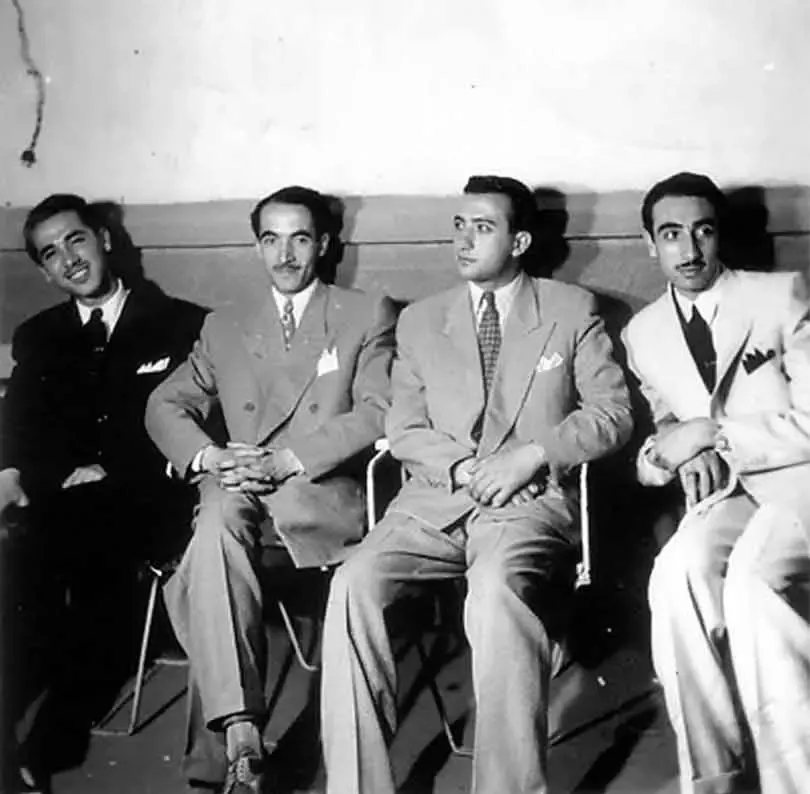
Right to left Jamshid Sheibani, Parviz Khatibi, Hamid Ghanbari, unknown
Bayat-e Tehran or Ghazal-e Koucheh-Baghi (Alley-Garden Ghazal)
A second distinct trend began with Badizadeh's recording of "Bayat-e Tehran - Nefrin-e Ashegh" (Bayat of Tehran - The Lover's Curse) in Syria in 1318 SH (1939 AD) on the "Sodwa" label.
This style centered on vocal ghazal-recitation, featuring themes of a lover's prayer or curse directed at the beloved. It was carried forward by artists like Morteza Ahmadi, Abdolali Homayoun, and Delkash throughout the 1320s and 1330s SH (1940s and 1950s).
In the 1340s SH (1960s), this form saw even more recordings on 45 RPM records by artists such as Masoudi, Parvin, Jabali, and even Googoosh. The style reached its peak and greatest diversity with the works of Iraj, whose signature ghazals include "Ghazal-e Banna" (The Mason's Ghazal).
From Film Songs to Koucheh-Bazaari Music
One of the most significant influences on popular Iranian music in the 1330s SH (1950s) was Iranian cinema and the Persian-language films of that era. A large portion of these films was dedicated to musical performances featuring popular figures who worked in various styles, from pop to cabaret music. These singers included Delkash, Parvaneh, Bahram Seir, Manouchehr Shafiei, Mahvash, Shahin, and Aafat.
This phenomenon was heavily influenced by two foreign sources:
- Arab Films: Their success hinged on the vocal artistry of major singers like Mohammad Abdel Wahab, Umm Kulthum, Farid al-Atrash, and Asmahan.
- Indian Films: Their popularity was fueled by the hit songs of singers such as Lata Mangeshkar, Noor Jehan, and Mohammed Rafi.
Furthermore, this trend can be seen as the natural continuation of the Pish-Pardeh-Khani (Overture Singing) tradition, adapted for the cinematic stage.
A specific branch of this movement, heavily influenced by Arabic melodies, was championed by well-known composers like Abbas Shapouri, Ebrahim Salmaki, Hassanzadeh, Goudarzi, and Pourhashemi. It achieved commercial success with vocalists such as Ghasem Jabali. Notable songs in this category include "Shaneh" (Comb), performed by Jabali and later by Pouran, and "Donya" (World), sung by Jabali.
This entire flow ultimately led to the formation of distinct styles, the most important and widely popular of which became known as "Koucheh-Bazaari" (Street-Market Music). The 45 RPM records of singers like Davoud Maqami, Hossein Movaffaq, Ahdieh, Rouhparvar, Aghasi, Sousan, and Abbas Ghaderi were met with enormous public enthusiasm.
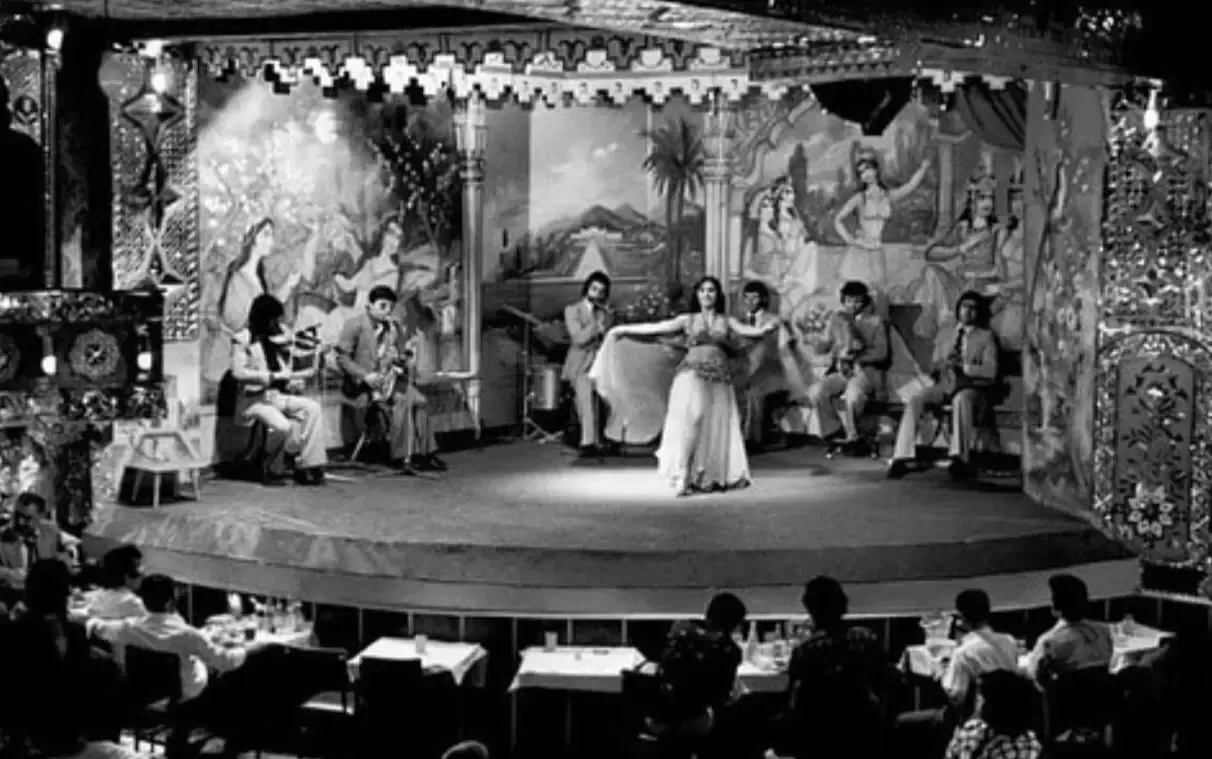
Golden Horizon Cabaret - Lalezar
Western Pop
The third major stream, unlike the previous two that appealed to the general populace, primarily targeted the more modern, educated, and university-aged youth. This trend involved replicating global musical patterns and forms popularized since the 1940s, such as the Rumba, Waltz, Tango, and Foxtrot.
The leaders of this movement in Iran were Ne'matollah and Fathollah Minbashian, who paved the way in 1325 SH (1946 AD) by recording twenty pieces in Bombay under the "Delbar" label. The following year saw the production of records under the "Tehran" label, likely influenced by Parviz Mahmoud in India, featuring lyrics similar to the works of Parviz Khatibi.
Alongside traditional orchestras, groups with international leanings emerged:
- The Jolly Boys Orchestra: Produced pop music for the Columbia company, collaborating with singers like Hamid Qanbari, Sonia Vartanian, and Stan Sperber.
- Selfurandi Trio: Had a similar mission for the Odeon label in Tehran, recording various pop pieces.
Initially, works performed by these groups in Persian, but often with an Armenian or foreign accent, weren't well received by the general public and were quickly deleted from catalogs. This issue had previously affected Parvin Aghababaeff at the Higher Music School before she was replaced by Rouhangiz, who was discovered by Hossein Sanjari.
Key Iranian Figures:
- Bahram Seir was one of the most important figures to record examples of Western pop music in Tehran in the late 1320s SH (late 1940s).
- Jamshid Sheybani traveled to the US to record LPs featuring global pop forms, benefiting from collaborations with well-known lyricists and composers.
The Role of Radio and Final Transformation:
The Radio played a critical role in popularizing and mainstreaming this style—which was often broadly referred to as "Jazz music" at the time—by regularly broadcasting "foreign" music.
In the second half of the 1330s SH (late 1950s), the Radio held contests to select pop (or Jazz) singers, with Manouchehr Sakhaei being the first winner. The first generation of 45 RPM vinyl records produced in Iran in 1337 SH (1958 AD) featured the works of artists like Sakhaei, Abbas Mehrpouya, Mohammad Nouri, and Vigen.
This stream matured significantly in the 1340s SH (1960s) with artists such as Googoosh, Ebi, Dariush, Farhad, and Fereydoun Foroughi. Although it sometimes overlapped with the distinct "Iranian Beat" movement, it was generally recognized as a separate, sophisticated trend that permanently changed the Iranian music landscape.
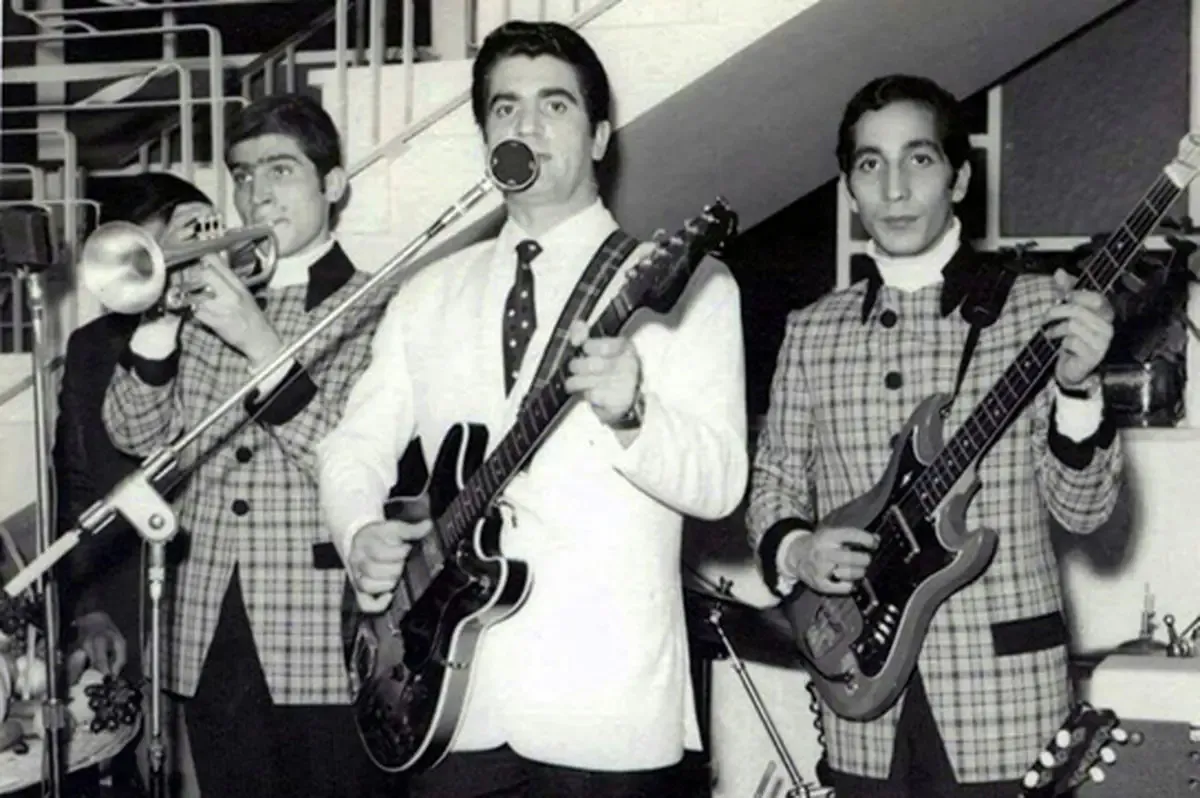
Viguen and his band
Iranian Beat Groups of the 1340s SH (1960s)
Iranian Beat Groups emerged in the mid-1340s SH (mid-1960s), coinciding with the global popularity of European Beat groups, especially The Beatles. This movement lasted until the early 1350s (early 1970s). These groups gained recognition through 45 RPM records and began their professional careers in cafés and nightclubs. While many of these groups were short-lived, The Golden Rings were the most prolific, releasing around ten singles.
Notably, the Armenian and Assyrian minorities played a significant role in the development of operetta, opera, and pop music. These groups typically performed not only covers of foreign songs and Iranian shish o hasht (6/8) melodies but also local folk tunes (such as "Fatemeh Soltan").
The structure of these groups generally fell into two categories :
Small Orchestras
These groups were a continuation of the first wave of global pop pioneers in Iran. They were often founded by a stylized singer or composer (like Vigen and Hovik) or had an amateur, guild-like nature. Their main focus was on performing global forms like Rock and Roll and Twist with Persian lyrics. Key examples include the Students Orchestra, the Album-e Rangi Orchestra (led by Ata'ollah Khorram), the Tehran Boys Orchestra, and the Maqsadi Group.
Conventional Beat Groups
These groups were organized to closely resemble international Beat groups. They typically consisted of four or five members who all participated in songwriting and vocals, and changing a member didn't necessarily lead to the group's dissolution. Examples include The Black Cats, The Odd Ones (A'joubeha), The Bells (Zangouleha), The Rebels, and The Golden Rings, the last of which warrants special mention.
Based on 45 RPM records, 31 Iranian Beat Groups and Orchestras have been identified so far. In alphabetical order, they include:
Album-e Rangi Orchestra, Arvin Mooreh Orchestra, Tehran Boys Orchestra, Students Orchestra, Hovik Modern Orchestra, Vigen Modern Orchestra, The Odd Ones (A'joubeha), The Black Cats, Big Boys, PasMaker, Persians, Piccolo, Tigers, Aces (Takhalha), Uproars (Janjalha), Dangers (Khatarha), Dynamics, The Rebels, Rainbow (Ranginkaman), The Bells (Zangouleha), Sa'eed, Ghost (Shabah), Resonance (Tanim), Friends, Flowers, Whirlwinds (Gerdbadha), Six and Eight Group (Gorouh-e Shish o Hasht), Maqsadi Group, The Golden Rings, Littles, and Invaders (Mohajemin).
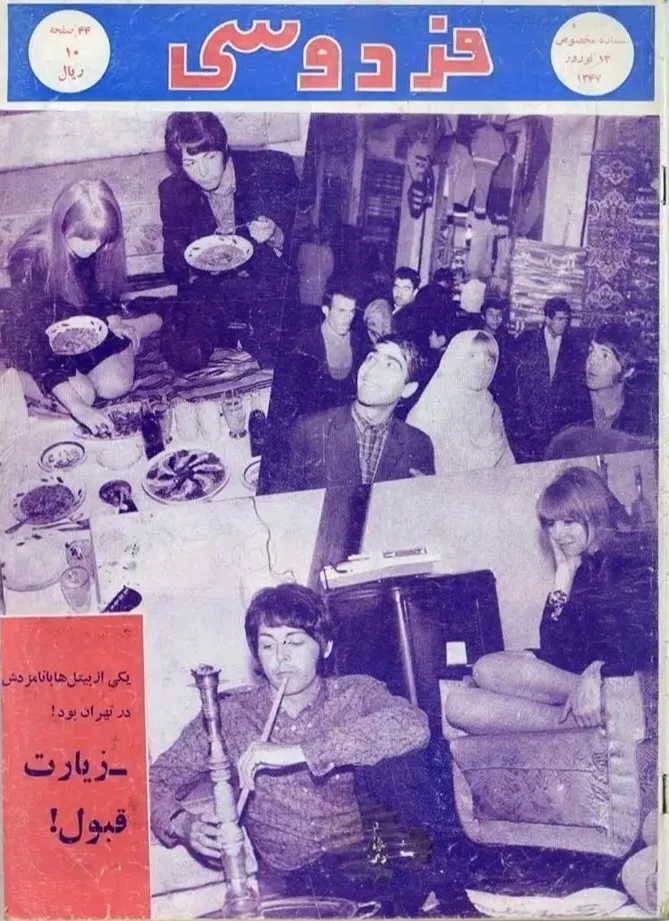
Ferdowsi magiazine showing The Beatles in Tehran
Persian Western Pop in the 1350s SH (1970s)
Iranian pop music underwent a profound transformation in the late 1340s SH (late 1960s) and early 1350s SH (1970s). This shift was driven by two main factors: global musical changes—specifically, the decline of cheerful Beat music and the emergence of the dominant Rock current—and the specific social conditions prevalent in Iran during that era.
These dramatic changes coincided with the arrival of a new generation of composers, lyricists, and singers, and even influenced the work of veterans.
- Abbas Mehrpouya, looking to world music, especially India, began pioneering a new compositional path by incorporating the sitar in his final works.
- Mohammad Nouri deliberately distanced himself from commercial works, choosing melodies with a strong Iranian local foundation. This marked his artistic boundaries more distinctly from the common Western pop forms.
During this period, several prominent singers established unique personal styles, distinguishing themselves from their earlier work and the mainstream trends:
- Farhad, with his album "Shabaneh" and tracks like "Jomeh" (Friday), moved away from his previous style with The Black Cats, developing a truly unique artistic voice.
- Dariush evolved beyond his artistic persona from the "Six and Eight Group" with introspective works like "Zendouni" (Prisoner) and "Booye Khoobe Gandom" (The Good Smell of Wheat).
- Fereydoun Foroughi, with his distinct deep voice, created a sound close to "Iranian Blues" in songs such as "Adamak (Divaneye Man)" (Little Man, My Madman) and "Gham-e Tanhaei" (The Sorrow of Solitude).
- Among female singers, Simin Ghanem, with songs like "Gholak-e Cheshat" (The Moneybox of Your Eyes), followed a similar path in developing an Iranian Blues atmosphere.
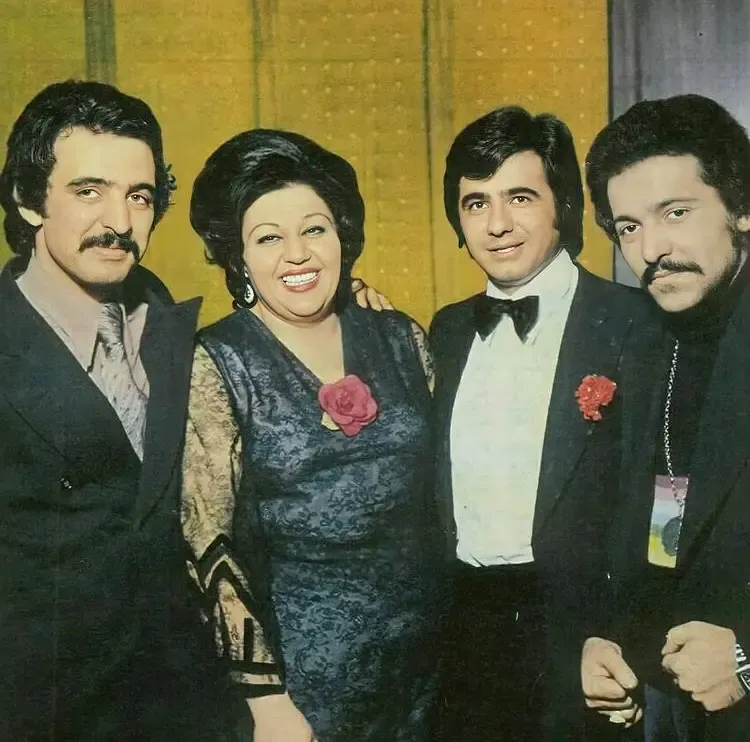
Farhad Mehrad, Aref Arefkia, Hayedeh, Fereydoun Foroughi
This prolific artistic environment, flourishing between 1348 and 1352 SH (1969–1973 AD), became the breeding ground for a younger generation of artists. Singers such as Ebi, Sattar, Morteza, Kamran, Hootan, Mohammad Roudgar, Mahmoud Vasfi, Touraj, Habib, and Amir Aram—some of whom reached the peak of their careers toward the end of the 1350s (late 1970s)—continued the path opened by these pioneers.
References
- Primary Article: Amir Mansour, "A Review of the Evolution of Global Pop Music in Iran," Persian Discography Journal #12, from the oirvm.ir 🔗 website.
- Ash'ār-e Āmiyāneh-ye Irān (Dar Asr-e Qājār) (Iranian Folk Poetry in the Qajar Era), Valentin Zhukovski, edited by Dr. Abdolhossein Nava'i, Asatir Publications, 1382 SH (2003 AD).
- Jozveh-ye Tasānif (Pamphlet of Tasnifs), Amir Jahed, 1308 SH (1929 AD).
- Article "Vaqti Dar Berlin Boodam" (When I Was in Berlin), Stone Record Journal (Journal-e Safheh Sangi), No. 9, p. 5.
- Majmoo'eh-ye Tasānif-e Towfīq (The Towfiq Collection of Tasnifs), from 1323 SH (1944 AD).
- Article "Abdolali Homayoun and Bayā Tehran," Stone Record Journal, No. 2, p. 19.
- Article "Safhehāye Delbar" (Delbar Records), Stone Record Journal, No. 3, p. 28.
- Article "Safhehāye Jamshid" (Jamshid Records), Stone Record Journal, No. 7, p. 3.